
Products · Overview

Whole process neutronics calculation, in one program

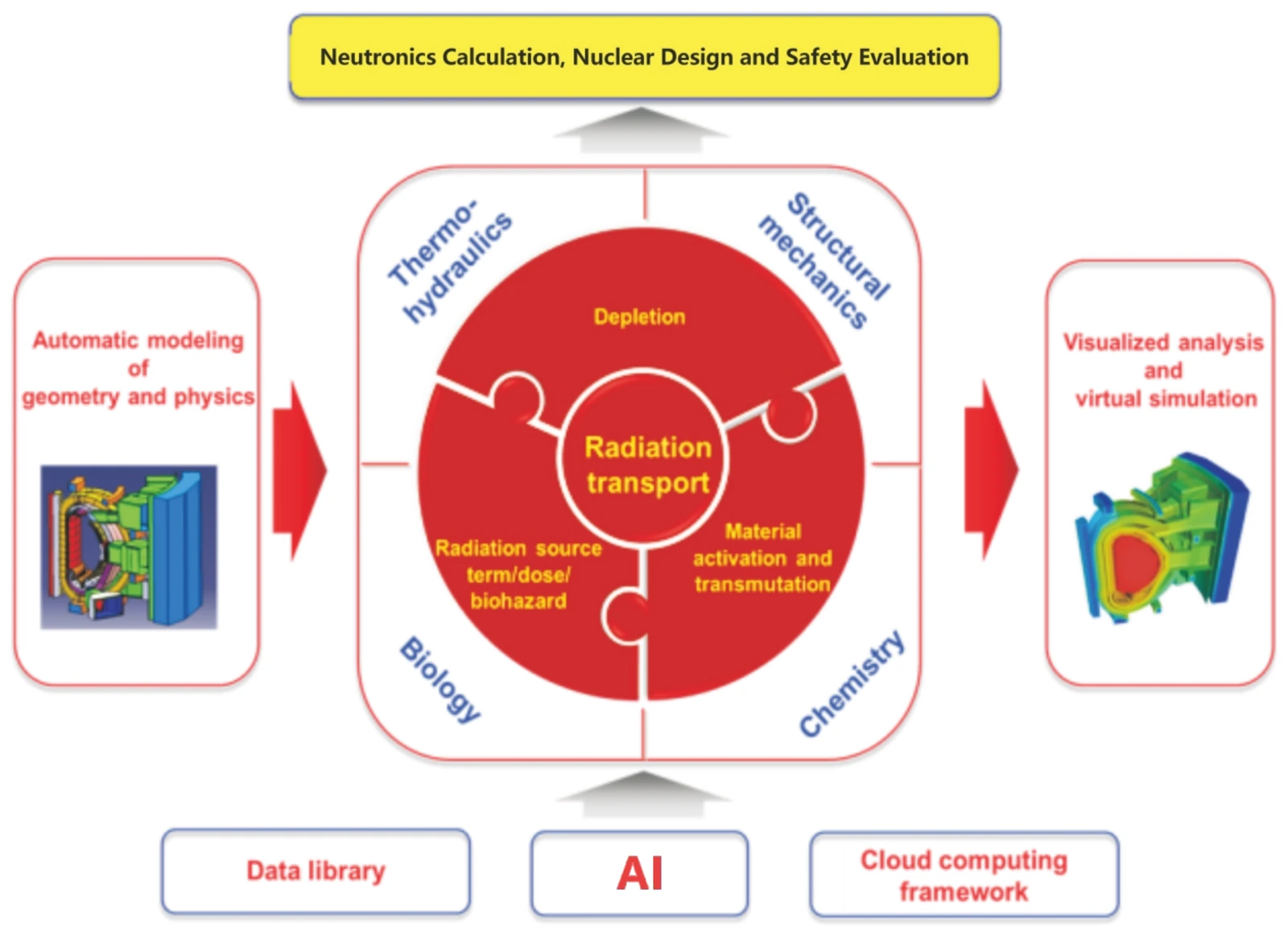
Multi-Functional Program for Neutronics Calculation, Nuclear Design and Safety Evaluation (TopMC, updated and extended version of SuperMC) is a large-scale nuclear design software, which has been developed by FDS Consortium for more than 30 years. Taking radiation transport calculation as the core, TopMC supports the whole process neutronics calculation containing depletion, radiation source term/dose/biohazard, material activation and transmutation.

It is featured with high efficiency and high fidelity multi-physics calculation, accurate modeling, visualized analysis and virtual simulation and intelligent nuclear design and safety evaluation. TopMC can be used for the design and safety evaluation of nuclear energy systems, as well as nuclear technology application fields.

TopMC has been widely used in more than 1000 well-known nuclear-related institutions in energy, healthcare, industry, in more than 90 countries. Related methodologies and technologies have won the National Natural Science Award, the European Prize for Innovation in Fusion Research, etc.

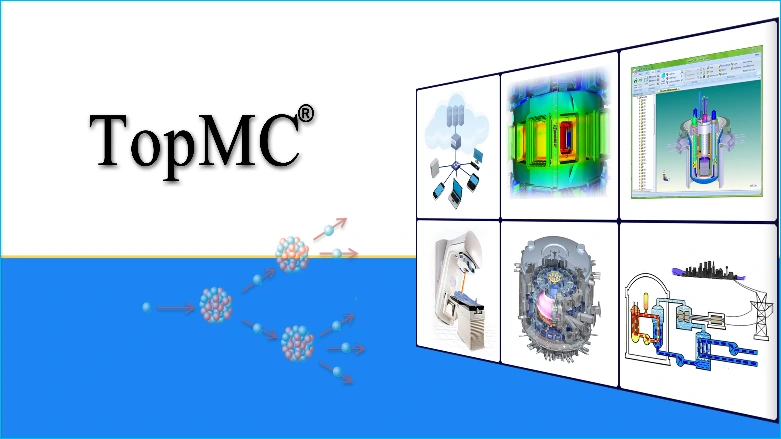
TopMC architecture: automatic modeling of geometry and physics, radiation transport core coupled with depletion, activation and source term, feeding visualized analysis and virtual simulation
TopMC architecture
  • Selected as the reference code by ITER
  • Passed the Generic Design Assessment (GDA) of the United Kingdom
  • Available from OECD/NEA and RIST/NCC
  • National Natural Science Award of China
  • European Prize for Innovation in Fusion Research

Products · Editions

Three editions, one transport core

The general-purpose neutronics program, a dose calculation engine for radiotherapy, and AI-driven nuclear design.

TopMC 1.1

Released

Updated and extended version of SuperMC

More powerful functions, more application fields and more professional services.

More powerful functions

  • Charged particle transport: electron, proton, ion, etc.
  • Highly efficient analysis: pulse height tally coupled with variance reduction, etc.
  • Deep integration of AI: intelligent modeling, intelligent computing, intelligent analysis, intelligent nuclear design, etc.
  • Multi-scenario solutions: neutron logging, radiography, accelerator, nuclear power, etc.

More application fields

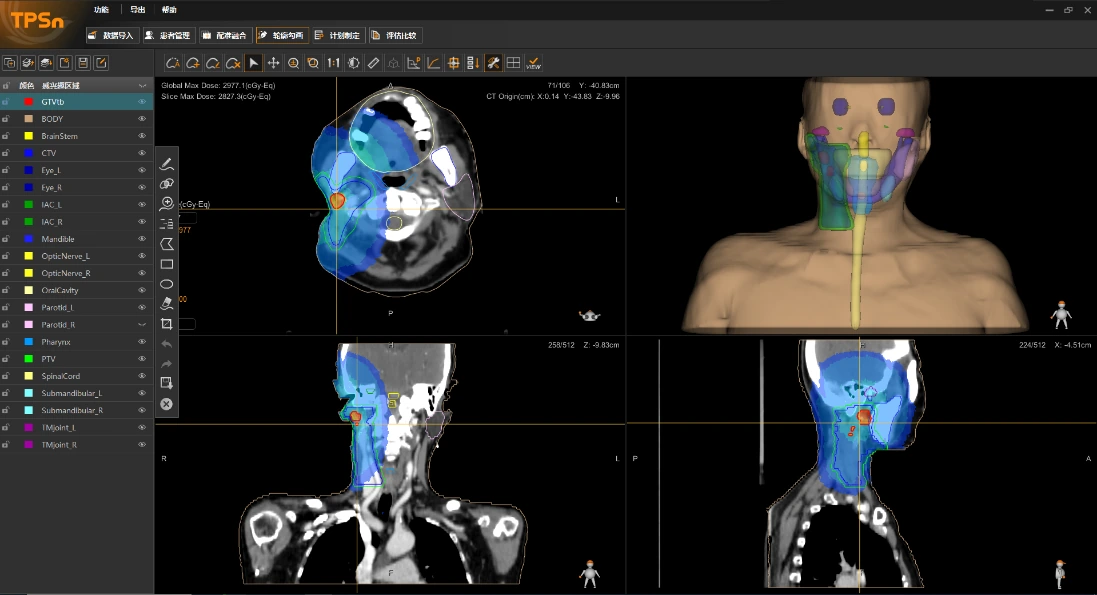
  • Extended to nuclear technology applications: design and application of nuclear detection and accelerators, dose estimation for radiation processing and nuclear medicine, etc.

More professional services

  • Standardized, professional services: pre-sales technical support, systematic training and after-sales service.
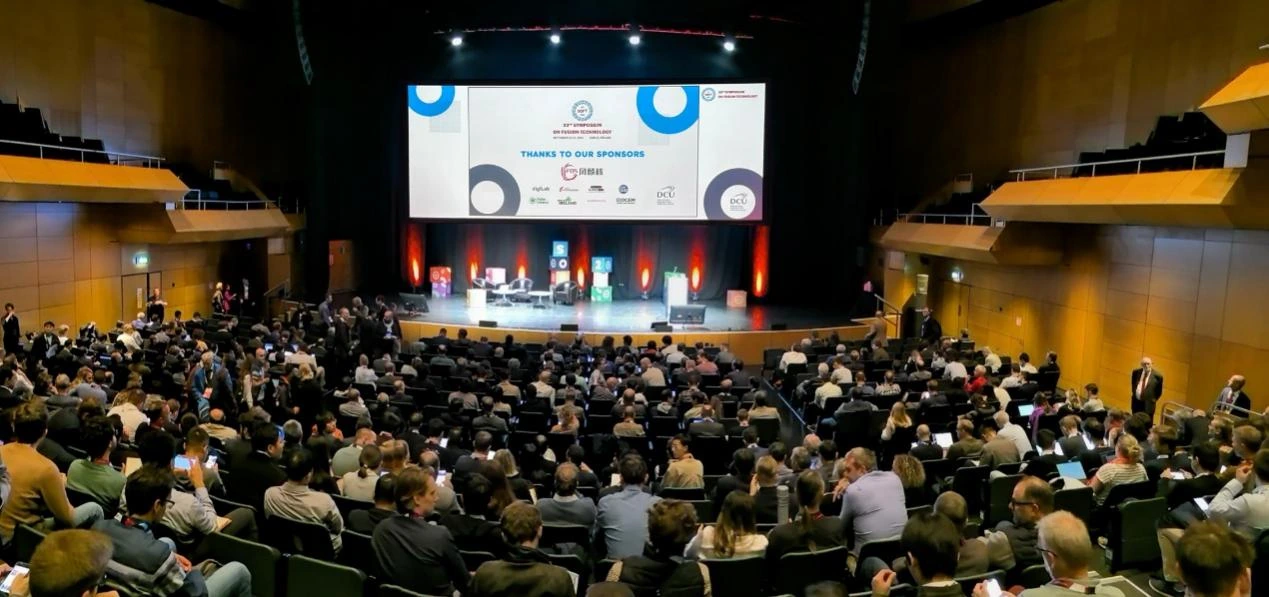
Plenary hall of the 33rd Symposium on Fusion Technology in Dublin, with the FDS logo first on the sponsor screen
FDS among the sponsors of the 33rd Symposium on Fusion Technology (SOFT), Dublin

Reference Chen S, Wu B, Dong Z, et al. Development of TopMC 1.0 for nuclear technology applications. EPJ Nuclear Sciences & Technologies, 2025, 11. DOI: 10.1051/epjn/2024033
Products · Functions

Eight calculation modules

Four basic functions cover neutronics simulation end to end; four extended functions couple it with other physics, people and events.

Basic functionsNeutronics simulation

01

Radiation Transport Calculation

  • Multi-particle: neutron, photon, electron, etc.
  • Flexible source description: general source, critical source, surface source, user-defined source
  • Physical parameters: keff, surface / cell / mesh / detector flux, energy deposition, reaction rate, pulse height, etc.
  • Adaptive variance reduction based on a global weight window generator
  • Efficient parallel computation: MPI, OpenMP, data decomposition parallel, etc.
  • Temperature-dependent cross section treatment: thermal & resonance, on-line / OTF
02

Isotope Depletion Calculation

  • Solving method: Chebyshev Rational Approximation Method (CRAM), etc.
  • Inner-coupling: beginning-of-step constant flux approximation (BOS), predictor-corrector, improved semi-predictor-corrector (ISPC), etc.
03

Material Activation and Transmutation Calculation

  • Computational modes: point activation calculation, transport-activation coupling calculation, etc.
  • Activation properties: activity, decay heat, biological hazard, dose rate, clearance index, etc.
04

Shutdown Dose Rate Calculation

  • Solving methods: Rigorous-Two-Step (R2S) and improved Direct-One-Step (D1S)

Extended functionsCoupling simulation

05

Multi-physics Coupling Simulation

  • Coupling neutronics calculation with thermal-hydraulics, structural mechanics, etc.
06

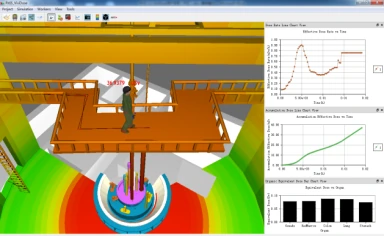
Organ Dose Evaluation based on Virtual Roaming

  • Virtual roaming of maintenance in radiation environments
  • Real-time evaluation of organ dose and collective dose
  • Automatic optimization of work paths
Virtual roaming scene of a worker on a platform above a reactor, with effective dose rate, accumulated dose and organ dose charts
07

Accident Evolution Simulation

  • Rapid prediction of the accident evolution process
  • Full-scale, real-time simulation of radionuclide diffusion
  • Accurate inversion of the accident source term
  • Intelligent decision support

Products · Advanced Features

What sets TopMC apart

01

Full-function, inner-coupled neutronics calculation

Strongly anisotropic neutron transport

  • Monte Carlo transport based on particle density uniformity for strongly anisotropic neutron transport problems
  • Perturbation analysis based on correlated sampling
  • Hybrid Monte Carlo and deterministic methods: region / energy / time coupling
  • Other acceleration methods: uniform fission source, data decomposition parallel, source convergence acceleration, massive tally scoring, etc.

Inner-coupled whole-process calculation — transport, burn-up / activation and dose

  • Full automation of the workflow for more efficient analysis
  • Data transfer through memory for high-precision calculation
TopMC collage: particle collisions beside panels showing parallel computing, a fusion device, a reactor model, radiotherapy, a tokamak and a power plant
One calculation chain across application scenarios
02

CAD / image-based accurate modeling for complex irregular geometry

Accurate automatic modeling

  • Conversion between CAD / image and Monte Carlo simulation models, accurately describing complex irregular geometry
  • Parameterized high-fidelity (pin-by-pin level) whole-reactor modeling

Integrated modeling

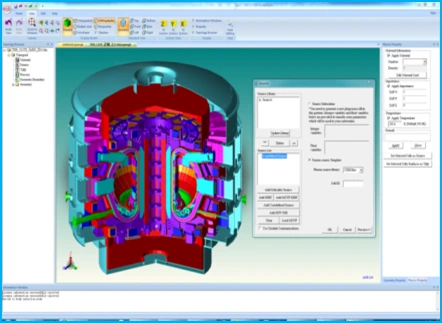
  • Whole-model interactive modeling for geometry, material, neutronics and physics-coupled modeling
TopMCdirect calculation
MCNPTRIPOLIGeant4FLUKAPHITSetc.input file generation
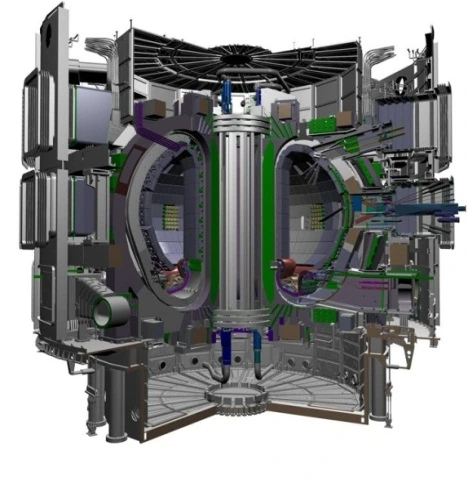
Cut-away CAD model of a tokamak with vacuum vessel, magnets and ports
CAD geometry of a tokamak
Modeling interface with a colour-coded reactor model and a source definition dialog
Interactive modeling
03

Data analysis based on multi-dimensional / multi-style visualization

Virtual-reality based simulation

  • Virtual roaming of maintenance in radiation environments
  • Real-time evaluation of organ dose and collective dose
  • Automatic optimization of work paths

Data visualization

  • Multi-style data visualization: surface / volume / iso-surface rendering, etc.
  • Visualization mixed with geometry
  • Quantitative analysis of results: point / extreme value extraction, trend analysis for a specified region, etc.
Virtual reality simulation: a worker climbs a ladder inside a colour-mapped radiation field while dose charts update
Virtual roaming in a radiation field
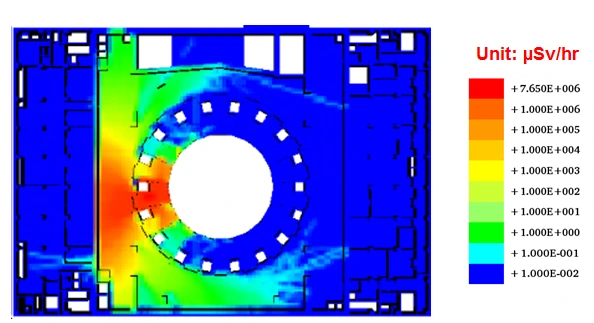
Dose rate map of a building floor in µSv/h, from red near the source to blue further away
Dose rate map (µSv/h)